
Run your freelance paperwork from one folder.
1099s from clients, the invoices you sent, deductible receipts, quarterly estimate records, signed contracts, business bank statements — dropped in, read on-device, and filed into the folders you already keep. Nothing is uploaded anywhere.
How do you organize freelance paperwork on a Mac?
ShabuBox is a document management app for Mac that handles it for you. Drag in the 1099s your clients send, the invoices you issued, receipts, contracts, and statements — or scan the paper ones — and on-device AI reads every page with Apple Vision OCR, pulls out the dates, amounts, and client names, renames the file from its contents, and files it into the folder structure you already use. Then you can search every word with ⌘K, or ask a plain-English question and get an answer with citations back to the page it came from. Your documents never leave your Mac.
A one-person back office that keeps itself.
Four steps, all of them local. There is no account to make and no server to run.
Get everything in
Drag in the PDFs that arrive from clients, payment platforms, and your business bank. Paper — a mailed 1099, a signed contract, a glovebox full of receipts — goes in through a scanner: ScanSnap over USB, any eSCL / AirScan network scanner, or a watched scan-to-folder for anything else. Crooked pages are deskewed and cropped on the way in.
It reads the page
Apple Vision OCR reads every page, including photographed receipts, so even a scan with no embedded text becomes searchable. On-device models work out what the document is — an invoice, a 1099, a contract, a statement — and extract the dates, currency amounts, and the people and companies named on it. The file gets renamed from its own contents.
It files itself
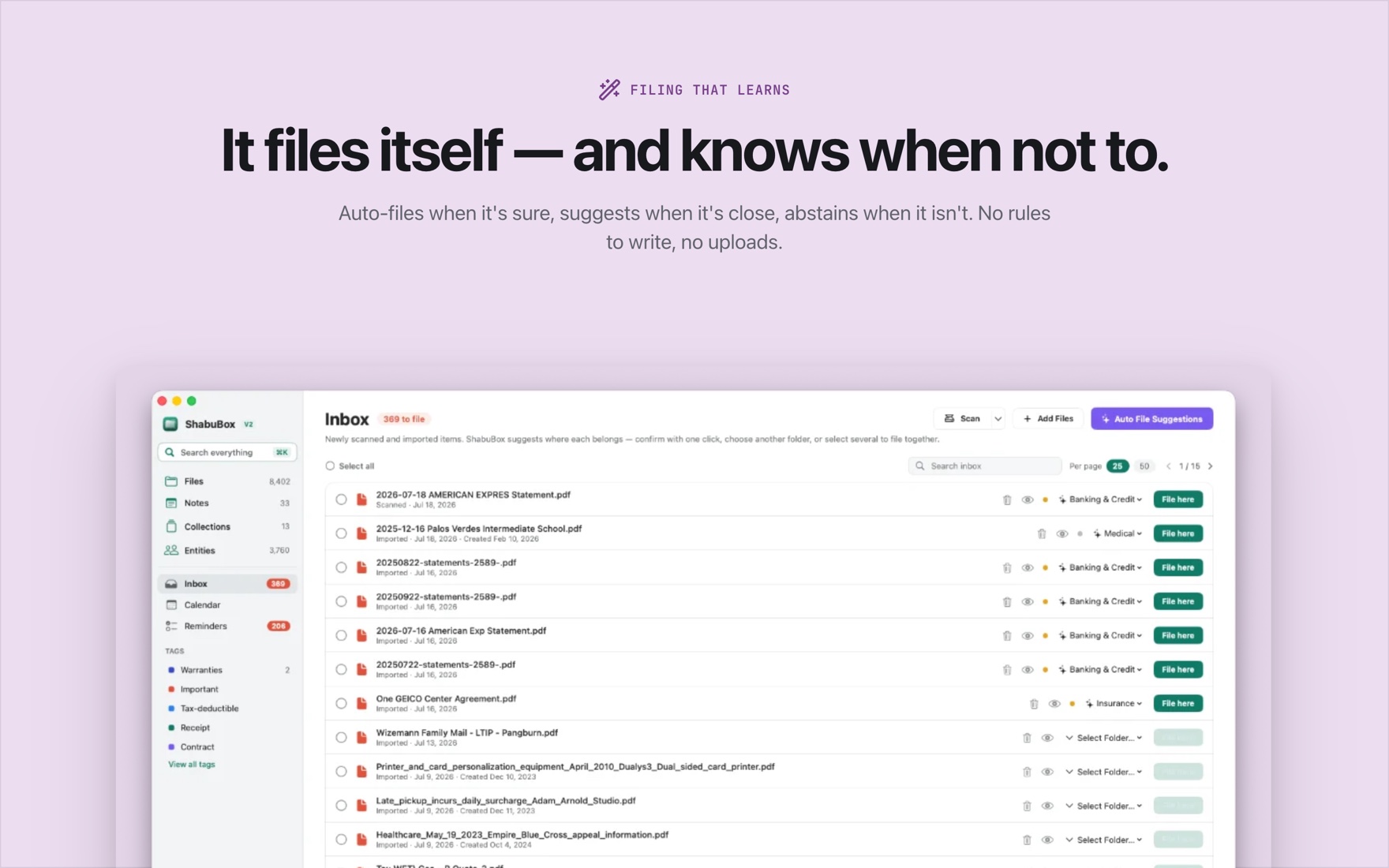
The auto-filer learns from where you already put things — if invoices for a given client live in that client’s folder, that’s where the next one goes. It files when it’s confident, suggests when it’s close, and abstains when it isn’t, so a contract never gets quietly buried under the wrong client. Everything new lands in the Inbox first if you’d rather confirm in a batch.
Find it at quarter’s end
⌘K searches every OCR’d word across files, notes, entities, and reminders — not just filenames. Or ask a question in plain English and get an answer where every claim carries a citation to the exact passage, so you can click through and check the source before it goes to your accountant or onto a form.
The paperwork of working for yourself.
- 1099-NEC and 1099-K forms from every client and platform.
- The invoices you sent, and the ones that came back paid.
- Deductible receipts, including photographed ones.
- Quarterly estimated-tax payment confirmations.
- Signed contracts, SOWs, and NDAs.
- Business bank and payment-processor statements.
- Software subscriptions, hardware invoices, and mileage logs.
- Business licenses, registrations, and insurance certificates.
Custom fields help here. You can define your own fields per document type — text, number, currency, date, or yes/no — so an invoice can carry a client, an amount, and a paid date. Filter the list to that type and it becomes a sortable table, one column per field. Reminders sync with Apple Reminders if you want a nudge before a quarterly payment or a contract renewal.
Client contracts don’t belong on someone else’s server.
Which is exactly why none of it is uploaded. OCR, document understanding, entity extraction, and chat all run on your Mac. There is no account, so there is nowhere for your contracts, rates, or client names to be held. Pull the network cable and importing, reading, filing, and searching still work. Your files stay ordinary files in ordinary folders you can open in Finder — the app’s database is only an index over them, and it can be rebuilt.
Not tax or accounting advice. ShabuBox organizes documents and answers questions from what they actually say — it doesn’t keep your books, calculate what you owe, or give tax advice. Check anything it tells you against the cited page, and talk to a professional about the actual filing.
Common questions about freelance paperwork
Does it separate business paperwork from personal?
It learns whatever split you already keep. If your business documents live in one folder tree and personal ones in another, the auto-filer picks that up from where you have filed similar documents before and follows it. It doesn’t impose a business-versus-personal model of its own, and when it isn’t confident which side something belongs on, it suggests instead of filing, or leaves it in the Inbox.
Can it total my deductible receipts for the year?
You can ask questions like that in plain English, and the answer comes back with an [n] citation to the exact passage each figure came from, so you can open the source page and confirm it. Treat it as a fast way to find and check the numbers on your own documents, not as bookkeeping arithmetic to file from.
Do I need accounting software instead?
They do different jobs. Accounting software keeps your books — income, expenses, invoicing, what you owe. ShabuBox manages the documents behind those numbers: it reads, files, searches, and answers questions about the 1099s, receipts, contracts, and statements themselves. Most people who need both keep both.
Is my client work uploaded anywhere?
No. OCR, document understanding, entity extraction, and chat all run on your Mac, and there is no account to hold your data. Contracts, rates, and client names stay as ordinary files in ordinary folders on your own disk. You can turn off Wi-Fi and Ethernet and importing, reading, filing, and searching all still work.
Can it tell which client a document belongs to?
On-device extraction pulls out the people and organizations named on each page, so a client’s name becomes something you can search and filter on. The auto-filer uses that along with the rest of the document to route it to the folder where you keep that client’s work — and when it isn’t confident, it suggests rather than guessing.
Try it on last quarter’s paperwork.
Every feature free for 30 days. Then $24.99, once — no subscription, no account, nothing that renews.
Also see: Taxes · Medical bills & EOBs · Home documents